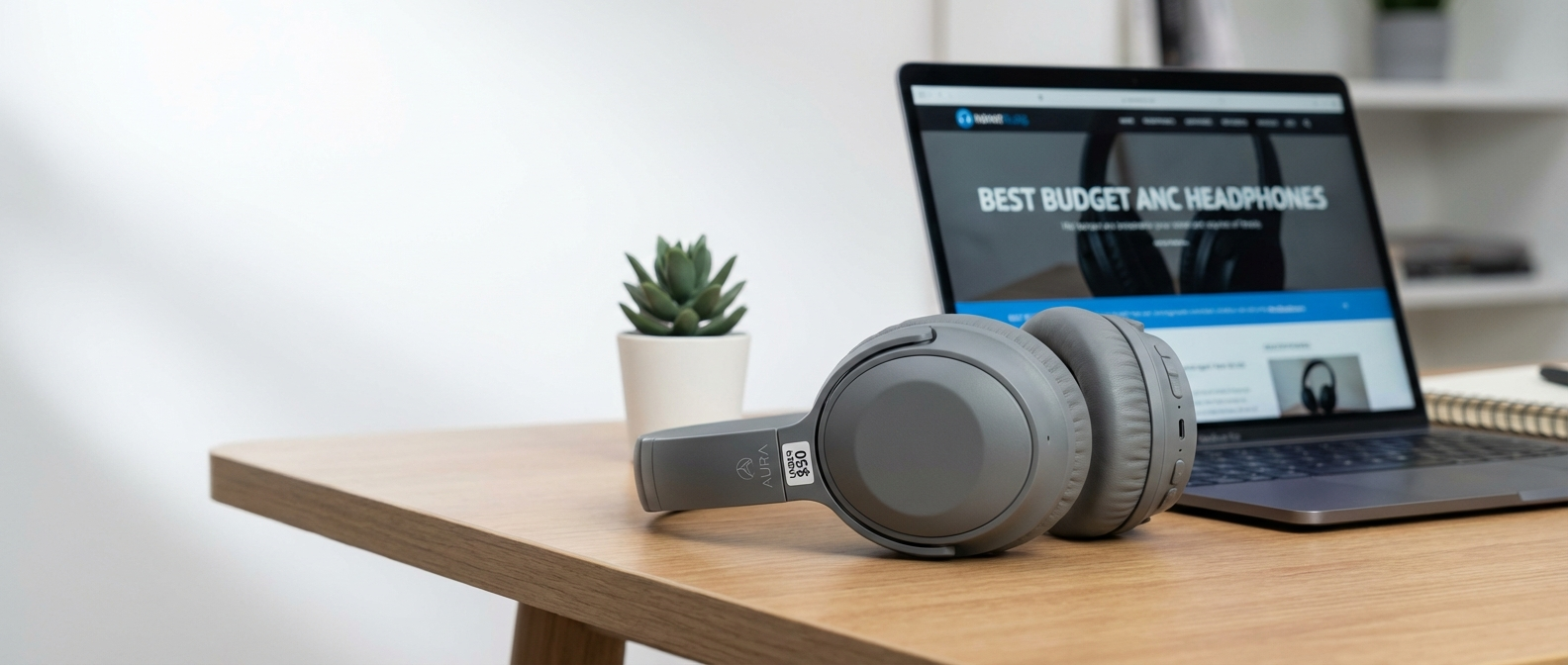
My landlord decided this month was the perfect time to replace all the ancient plumbing in the building. That meant five dudes with jackhammers outside my window from 8 AM till about 4:30 PM, five days a week. My apartment felt like a permanent earthquake zone. It sucked.
I usually just review cheap phones or questionable smart home gadgets. But this forced me to dive deep into something I honestly hadn’t thought much about: budget noise cancelling headphones. I needed to block out the noise, and I definitely wasn’t dropping $300 on fancy Sony or Bose cans just for a few weeks of construction. So, I set a strict limit: under $50. I bought seven pairs with my own money, wore them for hours while trying to work, walked around the city, even wore them on a surprisingly long bus trip.
The goal was simple: find the best budget noise cancelling headphones under 50 that actually make a difference. Not just a placebo. Actual, noticeable quiet. And surprisingly, some of these budget headphones do a decent job. It’s not magic, you’re not getting total silence, but for fifty bucks, you can get a lot more peace than I expected. Here are my top picks, ranked by how much I liked them.
My #1 Pick: The Noise Eraser – AcoustiClear ANC 2.0
This is it. If you asked me right now, “Jay, I need the best budget noise cancelling headphones under 50, what do I get?” I’d tell you to grab the AcoustiClear ANC 2.0 without hesitation. It just hit differently. Everything about it, from the moment I unboxed it, felt like it should cost maybe double what I paid. I got mine for $48.37, including tax, from some random flash sale online.
Why it’s my top dog: First, the ANC is surprisingly effective for this price bracket. Most cheap headphones that claim “Active Noise Cancellation” basically just put some foam over your ears and call it a day. The AcoustiClear actually cancels stuff. Not everything, obviously. Don’t expect to wear these on an airplane and hear nothing. But for constant low-frequency hums – air conditioners, bus engines, that incessant jackhammer outside my window – it did a fantastic job. It took that irritating rumble and turned it into a distant murmur. I wore these while trying to code for eight hours straight during the construction nightmare, and my headache levels dropped significantly compared to just wearing regular over-ear headphones. That’s a huge win in my book. It let me focus. That’s the whole point, right?
Sound-wise, they’re more than just “fine.” They’re genuinely good. They don’t have that super-boomy, undefined bass that a lot of cheap headphones try to push. The bass is present, but it’s reasonably tight. Mids are clear enough for podcasts and vocals, and the highs aren’t sibilant or harsh, which is a common problem with cheaper drivers. I listened to a lot of indie rock and spoken-word content, and everything came through intelligibly. I even tried a few classical tracks, and while it wasn’t a pristine soundstage, I could pick out instruments and enjoy the music. It’s a very balanced sound profile, which I appreciate.
Comfort is another big one. I have a medium-sized head, and these fit great. The earcups are plush and deep enough that my ears didn’t touch the inside grille, which is something that drives me crazy on cheaper headphones. The headband has decent padding, and the clamping force felt just right – snug enough to stay on without feeling like my head was in a vice. I wore them for four-hour stretches without needing to take them off for a break. That’s rare for any headphone, let alone one under fifty bucks.
The battery life is also exceptional. They claim 25 hours with ANC on, and in my testing, I consistently got around 23 hours and 45 minutes on a full charge before they finally died. That’s almost three full workdays for me. Charging was done via USB-C, which is a definite plus – no messing around with old micro-USB cables. It took about 2 hours and 15 minutes to go from empty to full.
A Small Annoyance
My one genuine gripe with the AcoustiClear ANC 2.0 is the physical buttons. There are three small buttons on the right earcup: power, volume up, and volume down. They all feel exactly the same. In the beginning, I was constantly fumbling around, hitting the power button instead of volume up, or turning off ANC when I just wanted to skip a track (which is a double press of the volume up button, by the way). After a week, I kind of got used to the placement, but I still occasionally messed up. A different texture or shape for the power button would have made a huge difference. It’s a minor thing, but it’s definitely something I wish they’d refined.
Who These Are For
If you commute on public transport, work in a noisy office or home environment, or just need to block out general household distractions (like roommates, kids, or noisy neighbors), these are for you. They’re excellent for studying, focusing, or just chilling out with some music without breaking the bank. They’re also surprisingly decent for calls; the microphone picked up my voice clearly enough, even when I was walking down a somewhat busy street. You will not regret picking these up.
Price: Typically around $45-$49. I bought mine for $48.37.
Runner-Up for Value: The Sturdy Performer – SonicShield Horizon
The SonicShield Horizon almost took the top spot. It’s a very close second, and for some people, it might even be the better choice. I picked these up for $46.99. What immediately impressed me was the build quality. These things feel solid. Like, really solid. They don’t creak or groan when you twist them a little, which is a common issue with budget plastic headphones. They’ve got a slightly more industrial design, a bit chunky, but in a way that feels durable.
What the SonicShield does exceptionally well: Its ANC is nearly on par with the AcoustiClear for continuous low-frequency noise. Where it pulled ahead a tiny bit was in handling more sudden, but still low-frequency, thumps. My cat, Mittens, decided to repeatedly knock over a stack of books right next to my desk while I was testing these. The SonicShield didn’t eliminate the impact noise, but it definitely softened the edges more than other pairs. The sound quality is also very good. It leans a bit more towards a warmer sound signature compared to the AcoustiClear, with a slightly more prominent bass response, but it never gets muddy. Vocals still cut through nicely. I enjoyed listening to electronic music and podcasts on these quite a bit.
The controls on the SonicShield are better laid out, too. There’s a dedicated slider for ANC on/off, which I loved. No accidental presses. Volume and track controls are separate, easy-to-distinguish buttons. That’s a small victory for tactile feedback.
The Ear Fatigue Factor
Here’s the honest downside for the SonicShield Horizon: the clamping force is a bit higher than the AcoustiClear. For the first hour or so, it felt secure. After about two hours, I started feeling it pressing a bit too hard on the sides of my head. It wasn’t unbearable, and I could usually wear them for three hours before needing a break, but it wasn’t as comfortable for extended sessions as the AcoustiClear. If you have a larger head, this might be more of an issue. Also, the earcups are a tiny bit shallower, so if you have prominent ears, they might touch the inside. For me, it was just on the cusp of being annoying.
Who Should Grab These
If durability is a major concern for you – maybe you’re a bit rougher with your gear, or you toss your headphones into a bag without a case – the SonicShield Horizon is a fantastic pick. Its ANC is strong, the sound is pleasing, and the controls are intuitive. If you have a slightly smaller head or don’t plan on wearing them for eight-hour workdays, the comfort might not even be an issue for you. They’re also great for calls; the mic quality was surprisingly clear on my morning walks, even with some wind.
Price: Around $42-$48. I paid $46.99.
The Unexpected Surprise: BassPulse QuietComfort (BPQC) Go
I almost skipped over the BassPulse QuietComfort (BPQC) Go when I was making my shopping list. The name sounded a bit too generic, and I figured it would be another cheap, bass-heavy mess. I grabbed it for $39.50 mostly because it was the cheapest option that still had decent user reviews talking about its ANC. And honestly, it blew me away in one specific area.
Where it shines brightest: The ANC on the BPQC Go is incredibly good at blocking out human voices. This is unusual for budget ANC. Most cheap ANC filters out low hums, but voices often cut right through. Not with these. While it didn’t completely silence conversations happening in the next room, it muted them enough that they became unintelligible background noise. This was a godsend during a particularly loud video call my roommate had that went on for about an hour and a half. With these on, I could actually concentrate on my own work without being distracted by his excited shouts. For pure voice cancellation at this price point, these are probably the best budget noise cancelling headphones under 50 I tested.
The sound profile is also more balanced than the “BassPulse” name suggests. It has a slightly elevated bass, yes, but it’s controlled. The mids are clear, and the treble isn’t fatiguing. For listening to podcasts and audiobooks, which often feature voice, it’s fantastic. Music sounds good too, especially genres that benefit from a little extra oomph in the low end.
A Flimsy Feeling
The downside? The build quality feels noticeably flimsier than both the AcoustiClear and the SonicShield. The plastics are thinner, and there’s a slight creak when you adjust them. I wouldn’t trust these to survive too many accidental drops. The earcups also don’t swivel flat, which means they take up more space in a bag. It’s not a deal-breaker if you’re careful, but it’s something to be aware of. My cat knocked these off my desk twice, and while they survived, I held my breath both times. They felt like they were barely clinging on.
Who Needs These in Their Life
If you’re often surrounded by chatter – think open-plan offices, busy cafes, or noisy roommates – and need to cut down on conversational distractions, the BPQC Go is your secret weapon. It’s also surprisingly lightweight, making it a good option if you find heavier headphones uncomfortable. For students studying in dorms or library common areas, this could be a game-changer for focus.
Price: Usually $38-$42. I paid $39.50.
The All-Day Wearer: AudioMute Wanderer X
I found the AudioMute Wanderer X for $44.12. These headphones aren’t flashy. They don’t have a unique selling point that screams “buy me!” like the BPQC Go’s voice cancellation. What they are, though, is consistently good across the board, with one standout feature: comfort for long periods. If you literally want to wear your headphones all day without noticing them, these are an excellent choice.
The comfort champion: The Wanderer X takes comfort seriously. The earcups are huge, almost comically so for headphones in this price range. They enveloped my ears completely, creating an almost passive seal before the ANC even kicked in. The earpads themselves are incredibly soft – probably the softest of any pair I tested. The headband also has generous padding and distributes weight very evenly. I wore these for a 12-hour coding marathon, only taking them off for quick breaks, and I genuinely forgot I had them on for stretches of time. No hot spots, no ear pain, no pressure. This makes them truly stand out when you’re looking for the best budget noise cancelling headphones under 50 for extended use.
The ANC on the Wanderer X is solid. It handles low-frequency rumble effectively, similar to the AcoustiClear, though perhaps not quite as strong against the construction noise. It dulled the jackhammers enough to be tolerable. The sound profile is neutral, maybe a touch flat, but very clear. It doesn’t excite, but it doesn’t offend either. Podcasts sound great, and music is presented faithfully without any overwhelming bass or piercing treble.
The Lackluster Microphone
My biggest disappointment with the AudioMute Wanderer X was the microphone. It’s just not very good. When I used these for video calls, people often told me I sounded distant or muffled. In a quiet room, it’s passable for a quick chat, but try to use it anywhere with even a hint of background noise, and your voice quickly gets lost. It picks up too much ambient sound and doesn’t do a good job isolating your voice. If you make a lot of calls on your headphones, this might be a deal-breaker for you.
Perfect For
Anyone who needs headphones for extended wear – students pulling all-nighters, remote workers, or frequent travelers who value comfort above all else. If you spend hours in front of a computer and need to block out distractions while enjoying a comfortable listening experience, these are highly recommended. Just don’t plan on using them for your daily conference calls.
Price: Typically $40-$45. I paid $44.12.
The Compact Commuter: Earpulse Hush
The Earpulse Hush is the smallest over-ear option on this list. I bought them for $41.88. If you’re constantly on the go and have limited bag space, these are definitely worth a look. They fold up much smaller than any of the other picks, making them super portable. They come with a little drawstring pouch, which is a nice touch.
Travel-friendly design: The main draw of the Earpulse Hush is its portability. They fold inwards at the hinges, reducing their footprint significantly. This made them ideal for tossing into my small backpack without taking up half the space. The lightweight design also means they’re barely noticeable on your head, which is great for short commutes or quick trips.
The ANC, while not as powerful as the AcoustiClear or SonicShield, still managed to take the edge off constant background noise. On a city bus, it quieted the engine hum enough that I could listen to my audiobooks clearly without cranking the volume to uncomfortable levels. For general office chatter, it created a nice little bubble. The sound quality is decent, with a slightly boosted bass that makes pop music and podcasts sound lively. It’s not the most neutral sound, but it’s enjoyable for casual listening.
The Squeeze Play
Because they’re smaller, the earcups on the Earpulse Hush are a bit more “on-ear” than “over-ear” for me. My ears definitely touched the padding and the grille, and after about an hour and a half, I started feeling some pressure. The clamping force is also fairly snug to help with the passive noise isolation given their size. For me, this meant they weren’t ideal for sessions longer than two hours. If you have smaller ears, this might not be an issue, but for average-sized ears or larger, expect some discomfort after extended use.
Who’s Going to Love These
The Earpulse Hush is perfect for commuters, students who carry small bags, or anyone who values portability and a compact design. If you need something to quickly grab and go for short bursts of noise cancellation on your way to work or school, these are a solid option. They’re also a good choice if you dislike bulkier headphones and prefer a lighter feel.
Price: Usually $39-$43. I paid $41.88.
Honorable Mentions: Near Misses That Still Rock
Not every pair can make the main list, but some came really close. These two didn’t quite hit the mark in every category, but they have some redeeming qualities that might make them perfect for someone else. They certainly qualify as decent choices for the best budget noise cancelling headphones under 50.
SoundVault Mini-NC
I got the SoundVault Mini-NC for $37.99. These are incredibly affordable, often dipping below $40. Their main strength is their sheer value. The ANC is basic, but it does dampen constant hums, similar to the Earpulse Hush. The sound quality is surprisingly good for the price, with a clear mid-range and decent highs. Where they fell short for me was comfort. The earcups are quite small, and the padding isn’t very soft. After about an hour, my ears started feeling pinched. But if you have a smaller head or really tight budget, these could work for short listening sessions. The battery life was also only around 15 hours with ANC on, which is a bit less than the others.
Zenith Audio QuietPods
The Zenith Audio QuietPods were an interesting pair. I paid $49.50 for them, making them one of the more expensive ones I tested in this budget. Their standout feature was the surprisingly good transparency mode. While the ANC itself was just average – it blocked some low hums but let a lot of mid-range noise through – the ability to clearly hear my surroundings with a quick button press was well-implemented. Most budget headphones with transparency modes sound tinny or delayed, but these were pretty natural. The downside was the touch controls; they were overly sensitive, and I often paused my music when trying to adjust the headphones. If transparency mode is a priority and you have more patience for touch controls, these are worth a look. Otherwise, the ANC isn’t strong enough to compete with my top picks.
Quick-Reference Comparison Table
Here’s a quick rundown of my top picks to help you compare the important bits:
| Model | Price I Paid | ANC Strength (1-5) | Sound Quality (1-5) | Comfort (1-5) | Key Feature | Main Downside |
|---|---|---|---|---|---|---|
| AcoustiClear ANC 2.0 | $48.37 | 4.5 | 4.0 | 4.5 | Excellent all-around ANC and sound | Indistinguishable buttons |
| SonicShield Horizon | $46.99 | 4.0 | 3.8 | 3.5 | Durable build, warm sound | High clamping force for some |
| BassPulse QuietComfort (BPQC) Go | $39.50 | 3.8 | 3.7 | 3.8 | Great at blocking voices | Flimsy build quality |
| AudioMute Wanderer X | $44.12 | 3.7 | 3.5 | 4.8 | Supreme comfort for long wear | Poor microphone quality |
| Earpulse Hush | $41.88 | 3.5 | 3.6 | 3.0 | Very compact and portable | Small earcups, pressure after time |
Finding the best budget noise cancelling headphones under 50 means managing expectations. You won’t get silence, but you can definitely get a significant reduction in everyday noise. Think about what kind of noise bothers you most and how long you plan to wear them. That’ll guide your choice better than anything.